Airspeed Video Episode – Spins with Barry

There are the show notes to a video episode. You can watch the episode in the viewer above or by clicking here: http://traffic.libsyn.com/airspeed/AirspeedSpinsBarry.m4v. Better yet, subscribe to Airspeed through iTunes or your other favorite podcatcher. It’s all free.

It’s time for another video episode!

I wanted to go up with Barry to do some acro to condition for the T-38 ride that happened on the 13th. Unfortunately, the Super D is no longer on the line at Oakland Flight Academy for financial reasons, which leaves only the Citabria. And the Citabria, not having a constant-speed prop, is limited to spins as far as acro goes. (And, even if we flew it fully acro, we’d be limited to positive-G maneuvers anyway.)

No problem. Spins are plenty fine to stimulate my vestibular system.

And, as long as I’m flying, it make sense to take along some cameras, if only to shoot B-roll for Acro Camp. This time, I took up a three-camera system so that I could show not only the view of the cockpit but the control inputs and an unobstructed view of what’s ahead of the airplane.

And it was a chance to try out the Multiclip functionality in Final Cut Pro, which is perfect for this kind of parallel-track editing (three cameras and an audio channel).

Like it says in the intro. DO try this at home. It could safe your life. Or at least improve your confidence in dealing with unusual attitudes. But be sure to do it in a duly certified airplane with a qualified instructor and in compliance with all of the regs.

Spins with Barry

I have a really cool Air Force ride coming up in California in a couple of weeks. Think helmet, mask, and speed jeans. (Yeah!) And, although I’ve filmed other people doing aerobatics a lot lately, I haven’t flown a lot of aerobatics. Out of respect for the crew chief (and personal pride), I decided to get up and crank an airplane around for an hour or so.
So I scheduled the Citabria and Barry for a couple of hours. We went out and did some falling-leaf stalls, an incipient spin or two, and then some genuine spins. Good kill-proofing no matter who you are and I highly recommend doing it at least once a year. And it was also enlightening in terms of the control inputs required. I really over-controlled the first couple of recoveries, but got pretty good about just relaxing on the subsequent recoveries.

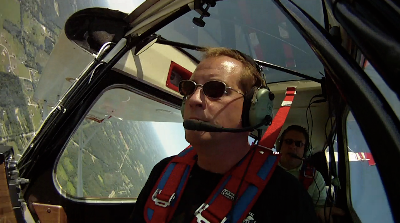
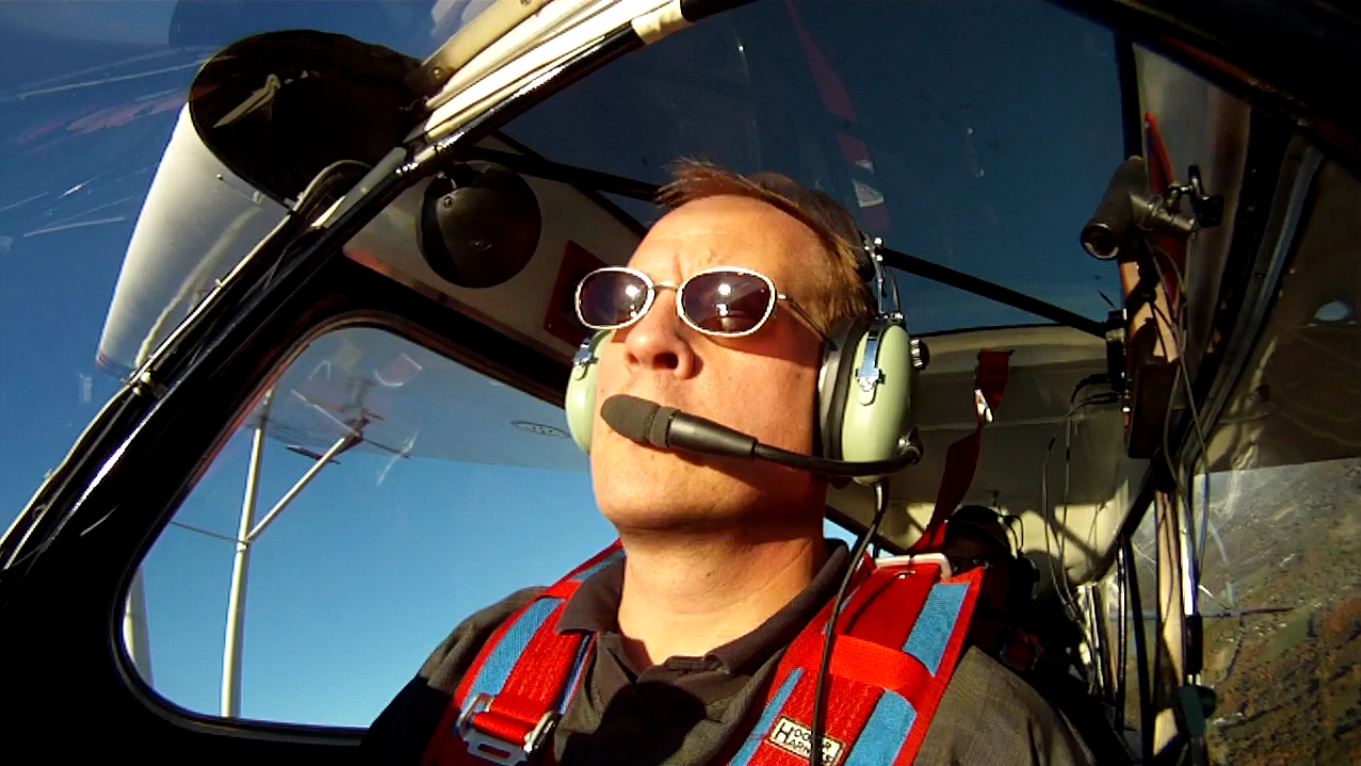
And, of course, I hung some cameras in (and on) the airplane. I might use some of the footage as B-roll for Acro Camp. But the primary use is likely to be an episode about spins. The in-cockpit camera leads this post. This one is a view from the wing camera. This is the first time I’ve flown a forward-facing wing camera with no airframe in the picture. I think it worked out beautifully and I’ll probably shoot more with this POV. The only change might be that I’ll land abnout five feet to the right of the centerline so that the camera (mounted on the left wing strut) is directly over the centerline, this giving the viewer a sense of floating in over the center of the runway.
I also flew a camera mounted directly above my lap to show the control inputs associated with the maneuvers. The stick disappears below the dash at some points, but the angle generally gives a good view of the controls. “Knees and nuts!” as my CAP NESA MAS instructor likes to say.

I’m off to the Battle Creek Airshow tonight and hope to get out to the balloon launch first thing tomorrow morning. Thus, I leave you with these teasers. More soon from Battle Creek!

Inverted Again!


This is a regular blog post. Check out the other posts for show notes and links to show audio.

I finally got inverted yesterday for the first time since November. Yeah!

About 1.7 hours with Barry Sutton in the Citabria yesterday. The mission was to get up and start rebuilding my aerobatic tolerance for the 2009 season and then continue with tailwheel training in the pattern.

We started with wingovers of varying degrees until I was getting her up to about 60 degrees, burying the wingtip, and still pulling her out well below the yellow arc. The idea with the wingovers was to get some sense of energy management back after not having flown the aircraft for months. Six or eight of those until I was nailing them pretty well both left and right.

Then we looped her. I do so love the loop. If I’ve been having problems, it’s been that I’ve relaxed the pull too early on the way up. Mostly, it’s getting a feeling of what it’s supposed to look and feel like in the airplane. This time, I think I nailed them pretty well. Good steady pull on the way up with only a little bit of letoff as I floated over the top and then begin the pullout as the horizon comes through the top (!) of the windscreen.

On the back of the last one, I actually felt like the airplane rotated a little around its lateral axis. Not sure if that’s good (too much pull and stall risk?), but it was an interesting sensation. This is a very capable airplane and we had plenty of altitude in which to recover, so I wasn’t worried. Additionally, I’m getting pretty good at managing the energy in each maneuver. On each of the last two or three loops, I kept the airspeed out of the yellow while still being pretty smooth.

Barry says that the loops were good and round and probably looked impressive from the ground. In fact, he says that the average layperson would assume that we had out cheeks in our laps pulling gees. Heck, I think it’s impressive regardless, but understanding how it’s different in the airplane from what you see on the ground is an added benefit of doing this. I get a lot better idea of what I’m seeing at airshows.

Aerobatic tolerance is about 20 minutes. Rotten. But I’m glad that I’m starting in early. I’d like to have it up to an hour of moderate aerobatics by early June. An organizer at one airshow that I’m covering this year says that he’s going to vet media riders in a Pitts S-2C before turning them loose to get media rides from the performers. Okay. (1) a Pitts S-2C ride is a great ride even if you never get past the vetting and (2) as long as I get to shoot and record in the Pitts, I’m good. Although I really do want to be the iron-stomached media rider who can handle whatever the performer throws at him.


I had a chance to try out the new camera rig. It performed very well. No gee-induced issues and the mount (from Pegasus Auto Racing Supplies) held the camera exactly where I wanted it. I put it on the tube to the upper left of the panel as seen from the front seat. The wide-angle lens gave a satisfactory breadth of view of the cockpit, but the sensation of motion wasn’t what I was looking for. I think I might need to mount it toward the center so that you get more outside view and get more of a sense of the aerobatic maneuvers.


The camera proved easy to operate from the pilot’s seat. You can’t see the controls from the pilot’s seat, but they’re fairly easy to operate by touch if you’ve futzed with the camera a bit on the ground first.

I managed to goof up the audio recorder during startup and didn’t record the intercom audio for this flight. So I’m going to have to use this footage for something else. But it’s good footage nevertheless. I’m looking forward to playing some more with the camera to figure out what works best. In any case, I don’t want to wait until it’s a really good flight opportunity to try to work out the bugs. I’ve just recently been approved by the Air Force for a really cool opportunity and I want all of the hardware working flawlessly when that gets scheduled.

I have the new MacBook Pro and I’m getting acclimated to it. I’ll be installing the video editing software soon and I’m looking forward to posting some exampled of the in-flight video soon.

More aerobatics and tolerance-building coming up! Stay tuned!

________________________
More information about Sutton Aviation:

Sutton Aviation, Inc.
Oakland County International Airport
6230 North Service Drive
Waterford, Michigan 48327
248-666-9160

Taildragger Training – Part 1


Subscribe to Airspeed through iTunes or your favorite other podcatcher. It’s all free!

These are the show notes to an audio episode. You can listen online right here by clicking:  http://traffic.libsyn.com/airspeed/AirspeedTaildragger1.mp3.

[Audio 01]

We’re going to do a little time travel here. Last April, when I had scheduled the DC-3 type rating course, I figured that it would be a good idea to get some tailwheel training before going down to Griffin. It seemed to stand to reason that it would be a good idea not to have my first tailwheel experience be in an airliner.

I actually needn’t have worried. Other than taxiing (which was an exercise in humility), the ‘three behaved beautifully.

But my tailwheel training has since become a lot of fun and I’ve spent a lot of time in a Citabria since then.


My instructor is Barry Sutton of Sutton aviation at Oakland County International Airport in Waterford, Michigan, although it’s “Pontiac” on the radio. The ICAO designator is PTK, for those following along in their A/FDs.

Barry’s a DE and an amazing instructor. John and Martha King have nothing on Barry for cockpit chatter. Barry is polished and smooth and seems to have a telepathic sense for what you need to know and immediately begins telling you before you have to ask. But Barry also has a talent for being quiet when he senses that you’re working things out, which is a rare thing indeed. I think Barry is the best instructor with whom I’ve ever flown. And I guess that’s saying something these days, as many people who’ve occupied the right seat in airplanes I’ve flown.

Anyway, I got ahold of Barry and scheduled a time to go get an intro to taildraggers and to go do some pattern work.


The airplane today is an American Champion Citabria 7ECA Aurora, tail number N157AC. It’s practically brand new, with its airworthiness certificate issues in December of 2006. It’s powered by a Lycoming O-235-K2C that puts out 118 horsepower at 2,800 PRM and it’ll climb at 740 fpm at sea level. It’s 22 feet long, 34 feet wide, and has 165 sq. ft. of wing area, giving it a wing loading of 10 lb./sq. ft. at its max gross of 1,750 lbs. It’s also certified for basic aerobatics and is rated for +5/-2 gees. I

t seats two in tandem. I’m in front for these flights. It’s a little weird if you haven’t flown a lot in tandem airplanes. You don’t see the instructor directly, so his or her voice is just sort of there in your ears. Like a voice in your head that’s teaching you to fly. Note: If you still hear a voice in your head telling you how to fly when you’re solo, consider a precautionary landing and some rest.

As a note for future episodes, I’ve done a lot of aerobatic training in it and recorded a lot of audio and video that will appear in future episodes.

Flying a taildragger is different in many ways. Probably the most important is that the center of gravity is behind the main gear. If you think about it, that’s an important thing because, if it wasn’t, the airplane would simply rest on its nose with the tailwheel in the air.

The most important consequence is that taking off and landing in a taildragger is a little like pushing rope. If there’s any off-center drag or friction, the center of gravity is going to want to come around from behind you and get in front of you. In a taildragger, that’s called a ground loop and it’s embarrassing at best and can bend you and/or the airplane at worst.

Think of it like this. The nest time you’re in a grocery store parking lot, go grab a shopping cart. Turn it around backwards and put your forearms on the sides of the cart, rest your elbows on the front corners, and grab the sides with your hands. Now run really fast. The cart isn’t very graceful and it gets worse the faster you go. That’s a pretty good proxy for what it’s like the first few times you fly a taildragger.

One other thing as we get started. Barry talks a little about an imaginary nosewheel. He is, of course, addressing the fear by tricycle-gear drivers like me that pushing the nose over will result in a prop strike. The fact of the matter is that there’s a fair amount of downforce on the tail of the airplane and you’d actually be hard-pressed to have a prop strike. Even if you got pretty well beyond level, the prop would tuck under a bit before actually striking the runway.

For all normal operations, you can simply imagine that there’s a nosewheel in front and you don’t even have to imagine very hard. After a certain amount of forward force, the airplane will resist you pretty well and the nose feels pretty stable.

Also, this is my first time flying an aircraft with a stick. You hold the stick in your right hand. Push and the houses get bigger, pull and they get smaller. Left and right are as you’d imagine. The throttle is a knob on the left wall and the carb heat is a smaller knob just below it and you operate those with your left hand. Trim is also on your left, but it’s only marginally helpful for gross adjustments. It’s almost impossible to trim the airplane for hands-off level flight.

The transition from yoke to stick took ten seconds. I’m not kidding. It seemed completely natural immediately. And I love, love, love flying with a stick instead of a yoke. I’d have to get a different kneeboard if I was going to fly the Citabria IFR (and, by the way, it’s IRF certified), but I’d consider doing that. As it is, I fly it without a kneeboard and take notes on my right knee with a fine felt-tip marker. Right on the knee. A prouder tattoo one cannot imagine. In fact, I’ve often considered writing an ATIS on my knee before going out just because I think it looks cool.

The first order of business was to familiarize me with the feel of the rudder at high speed before rotating. To that end, Barry and I did two high-speed taxis down Runway 27L. Barry had the stick and the throttle and got us moving just fast enough to get the tail off the ground. I’m sitting up front with my hands in my lap and feet on the rudders.

Here’s the first high-speed taxi.

[Audio 02]

Not bad. We taxi back and do another one.

Barry and I talk about the first run and get ready for the second one.

[Audio 03]

Then it’s time to do the second high-speed taxi.

[Audio 04]

We taxi back to the approach end of 27L. this time, we’re going to take off. The wind is pretty heavy out of the south and I’m not ready to crosswind operations in this airplane yet. We’re going to ask for a right turn on takeoff and make right traffic around to Runway 17.

You can land a taildragger in two ways. The easier and more common is the three-point landing. As the name implies, you try to touch the mains and the tail all at the same time. A three-point landing is a little easier in the Citabria because the tailwheel is steerable and you have more directional control when the tailwheel is down.

The other kind is a wheel landing. In a wheel landing, you land on the mains and then let the tail fly until it can’t fly anymore. It’s much the same as takeoff except that you’re slowing down. It’s also a lot harder because (a) as a tricycle-gear pilot, you’re overly scared of nosing over and having a prop strike and (b) you don’t have that steerable tailwheel on the ground and you’re instead depending on the rudder for directional control, even though rudder effectiveness is decreasing all the way until the tailwheel makes contact.

All of the landings today will be wheel landings. That’s because the DC-3 almost always does wheel landings. Unlike the Citabria, the ‘three is very stable in a wheel landing. In fact, although the ‘three can and does do three-point landings, it’s discouraged because the tail could begin oscillating up and down and, when a tail that big with that much momentum starts to oscillate, you can have control departures, prop strikes, and other nastiness.

But the Citabria is a good platform for understanding what goes into landings of either kind and we’re going to do some wheel landings today.

Here’s the takeoff from runway 27L and part of the pattern over to Runway 17. You can tell that I’m really enjoying the way this airplane flies.

[Audio 05]

And here’s the approach and the first landing. There’s a lot of convection and other turbulence, so you’ll head Barry coaching me on the throttle until I get the approaches dialed in.

[Audio 06]

Not awful, but I can tell that Barry’s doing a lot of the flying on the landing. We taxi back to the approach end of Runway 17 and I get my second takeoff. I feel pretty good about the takeoff and do most of it myself.

[Audio 07]

We get through the thermals and it’s time to touch down again. I don’t keep the stick forward to keep the tailwheel off and Barry helps me out with that. I’m exhibiting ever reaction that you’d expect from a tricycle-gear pilot flying a taildragger for the first time.

[Audio 08]

We head around the patch again and I put in my worst landing of the day. I keep wanting to pull back when I need to be disciplined enough to keep it forward to keep it on the mains and keep the tail off the ground. This time, we have to play with the power and oscillate a few times before getting the aircraft down and stopped.

I should mention that Pontiac is a pretty big airport with parallel main runways in addition to the crossing runway that we’re on. It’s a rare time when we have the airspace pretty much to ourselves. Barry’s friendly with the guy in the tower and I take the opportunity at the end to try to cloak my landing in a PIREP.

[Audio 09]

We got something like seven takeoffs and landings that day. Here’s the last one. It was a little better than most, but I still didn’t push adequately and we had to play with the power in order to get the right attitude for touchdown.

[Audio 10]

Needless to say, about a month later I had a tailwheel endorsement from Dan Gryder in the DC-3. The ‘three was much easier to fly than the Citabria in many ways. Lots more on the checklist and much more technical to get her over the fence but, once over the fence, docile as could be.

My understanding with Barry is that I’m going to fly the Citabria with him until he tells me that he’d sign me off for a tailwheel endorsement in that aircraft. Then I’ll really feel that I’m a tailwheel driver. Most of the flights since then have been aerobatic for the first hour and then pattern work after that. As I record this in mid-January, I haven’t been up in the Citabria since November, but I’ll be back in the saddle as soon as I can get there.

I think the Citabria is my favorite training aircraft thus far. It’s yellow, it’s new, it’s clean, it has great visibility (including a transparent roof), you sit on the centerline, you have your feet up on the rudders, you have a four-point harness, and it’s a genuine stick-and-rudder pilotmaker. Captain Chris of Plane madness did an informal poll on Twitter a few months ago, asking, if money was no object, what two aircraft would you own. I responded with the F-86 Sabre and either a Citabria or the Citabria’s big brother, the Super Decathlon. It’s that much fun.

Stay tuned because there’s lots more tailwheel and aerobatic audio stored up from the last year. And I’ve shot a lot of cockpit video of the aerobatic stuff, so I’m planning to release some more video episodes, too.

Contact Barry Sutton at Sutton Aviation:

Sutton Aviation, Inc.
Oakland County International Airport
6230 North Service Drive, Waterford, MI, 48327
248-666-9160

UPDATE as of February 2012:

N157AC is now on the line at FLight 101 at KPTK.  Contact information:

2121 Airport Road
Waterford, Michigan 48327
Ph: 248-666-2211
Fax: 248-666-1094
flight101school@yahoo.com

1.4 Aerobatics and Tailwheel and Taxiing the Kids


Subscribe to Airspeed through iTunes or your favorite other podcatcher. It’s all free!

These are the show notes to an audio episode. You can listen online right here by clicking: http://media.libsyn.com/media/airspeed/AirspeedCitabria1.mp3.

(Lead photo by Nicholas (“Cole”) Tupper.)

Got up in the Citabria yesterday for a training flight. 1.4 hours of mostly aerobatics and landings. The plan was to go out, review the maneuvers that I’ve been working on up until now, and then do some spins, sort of as a killproofing exercise.

The aerobatics worked out well. Wingovers, loops, rolls, and hammerheads. Last time, I was at the point where the loop was mine. I flew them more or less without coaching (at least after a little review and coaching on the first one or two). This time, I added the hammerhead to that category. I’m getting good vertical uplines and downlines and handling them with good energy management (e.g. I get a good amount of time in some of the more dramatic accelerative phases while still recovering in plenty of time to keep the airspeed well within the design tolerances of the aircraft). I’m really pretty proud of that.

Same with the rolls. A roll in the Citabria involves picking up energy with a dive to about 120 MPH IAS, leveling out briefly, and then burying the ailerons left. You roll 360 degrees, pulling power smoothly throughout, and then you end up wings-level on a 45-degree downline (which you maintain for awhile), and then you recover. You lose a lot of altitude (500 feet or so) pretty quickly, which was news to me when we started, but it’s actually a very elegant move. You get and then give energy in an elegant, disciplined, precise, and measured way.

Inversion tends to bother me, even when I’m on the controls, and, by the time we got to the spin part, I was pretty green.

Barry gave me a pretty good lecture and demonstration of what secondary stalls can look like in likely scenarios. Still technically under control, but oscillating toward departure from controlled flight. We did one sustained falling-leaf stall, broke it, and pulled way-nose-high into a secondary stall, which, in turn, broke more savagely and dropped a wing hard. I’m sure that the third iteration would have been even more violent and that was the point of the exercise.

Barry’s teaching is really well-structured in that he always starts out with the reason that he’s teaching what he’s teaching and, if possible, a demonstration of how the maneuver applies in actual situations.

Just when we were ready in the training sequence for the actual spins, my tummy informed me that it had had enough. Discretion is the better part of valor, even though I had a Sic-Sack in my pocket and ready to go. I’ll get the spins in later this fall.

We headed back to the airport and got in four or five three-point landings. I was really pleased with the landings this time. I think I’m finally getting over one of the bad habits that plagues tricycle-gear pilots transitioning to tailwheel. I’ve been relaxing the back pressure on the stick after touchdown in much the way a tricycle-gear pilot would do to lower the nosewheel. In a tailwheel, you want to get the tailwheel down and keep it down. It both keeps the tail from oscillating and gets the steerable tailwheel down on the ground where it’s effective. Although I ballooned the last flare pretty badly, the landing worked out well and all of the landings had much more of a feel of positive control than I had experienced before. Very nice! I think I’m getting it. I realize that wheel landings will be another matter entirely, but I’ll revel in such success as I’ve had so far.


I took Cole and Ella out to see the Citabria earlier in the day. I don’t think I’ve ever had then in a taildragger before and they really seemed to like the tandem seating. Cole is really beginning to understand how the flight controls work. I can tell because, when he moves the controls, he looks right at the relevant control surface without casting about. You can see in this picture that he’s pulling and looking back at the elevator.


Ella, starting out in the back seat, expressed a little consternation about the stick moving around, apparently unbidden, as Cole worked the controls in front. She happily rotated up front and really seemed to enjoy seeing the different cockpit configuration.


And here’s the coolest part of the day. The Citabria is owned by one of the instructors at Sutton Aviation and he leases it back to the school. He happened to be walking out on the ramp with a student and noticed me taking pictures of the kids in the Citabria. He knows that I’ve been training with Barry and I had ducked in when I arrived to make sure that it was okay to show the kids the aircraft. He also knows that I have a tailwheel endorsement from the DC-3 training, but that I’m conservative enough to come back for more training from Barry in the Citabria in order to really learn the ins and outs of conventional-gear aircraft.

“Hey, why don’t you start it up and taxi the kids around the ramp a bit? I’ll bet they’d love that.” They’d love that? I’d love that!

My wife is wonderful and has been very tolerant of my flight training. Especially considering at least one event involving an instructor during my primary training. Even when I started taking aerobatic training, she didn’t object and she listened objectively when I explained the additional margin of safety that upset recovery and related training adds to regular GA flying. Heck, I had had thought long and hard myself about it before talking about it with her.

She’s not nuts about the idea of me flying the kids just yet. She approved getting up for a helicopter flight at Oshkosh and also said that it’d be okay to take Cole along if a spot had opened up in the back of the Herpa DC-3 (although she asked a lot of questions about Dan Gryder, all of which were easy to answer). But she’s still getting comfortable with the idea of me flying Cole or Ella.

In the meantime, I honor her feelings. I take the kids to the airport regularly and we ramp-fly whatever’s on the line, but they’ve never been in a GA aircraft with the prop turning.

That’s why this was such a cool opportunity. You normally wouldn’t go through the trouble of starting up an airplane and taxiing it around if you weren’t going to fly it. It had not even occurred to me to do it. But now we had a quiet ramp in a sleepy little corner of the airport. Plenty of room to taxi around and a gorgeous little taildragger in which to do it.

He didn’t have to offer twice. “Okay, guys, get in here and let’s taxi the airplane around a little.”

Cole started jumping up and down, saying “this is so cool!”

I got them in the back seat, buckled everybody in, ran through the startup checklist, and hit the starter button. The prop turned through about 20 blades and then the engine fired to life.

I looked over my shoulder and they were both smiling from ear to ear. Any worry that either of them would be scared by the noise or uncomfortable in the airplane melted away. All of that time pressed up against the fence in the front row at airshows over the last three or four years had paid off.

I ran all of the pre-taxi checks and then eased the throttle forward. Inertia gave way and we taxied happily around the ramp. I took it slow, but delighted both them and me by adding a little throttle and inside brake to swing the tailwheel around at each turn. Then we taxied back to the starting point and whirled the tail around in a tight 180 before shutting down.

“That was the coolest two minutes of my life!” shouted Cole. And it was a pretty cool two minutes of mine, too.


I’ll get the kids up sometime. There’s no hurry, really. It’ll happen when it happens. And it’ll happen after continued demonstration of my competence, skill, and judgment as a pilot when Mary’s comfortable with the idea. But, in the meantime, it’s a really good feeling to know that the kids are excited about it and it’ll be a big thing for them when it happens.

This is how it happens, folks. This is the magic of general aviation. The smell of 100LL, the sound of an engine, and the spark of imaginations on fire. Take your kids to the airport! I’ll see you there.